How many bars are there in Spain? Explore the most complete interactive map of the country
Bars in Spain are much more than a business — they are a social and cultural institution. They embody the heartbeat of villages, neighbourhoods and cities alike. At Accumin Intelligence, we have analysed extensive data to answer one of the most frequently asked questions online and off: how many bars are there in Spain?
The answer confirms what many might suspect: Spain leads the world in bar density, with one bar for every 207 people. Yet the real insight lies in the detail. The distribution is far from even. When you visualise the data through our interactive map of bars in Spain, remarkable contrasts emerge.
Explore the map
Epicentres of life and territories without a bar
Our analysis reveals a fascinating landscape: while some areas show a high concentration of establishments, others have become true “social deserts”, where the absence of bars reflects a deeper demographic crisis.
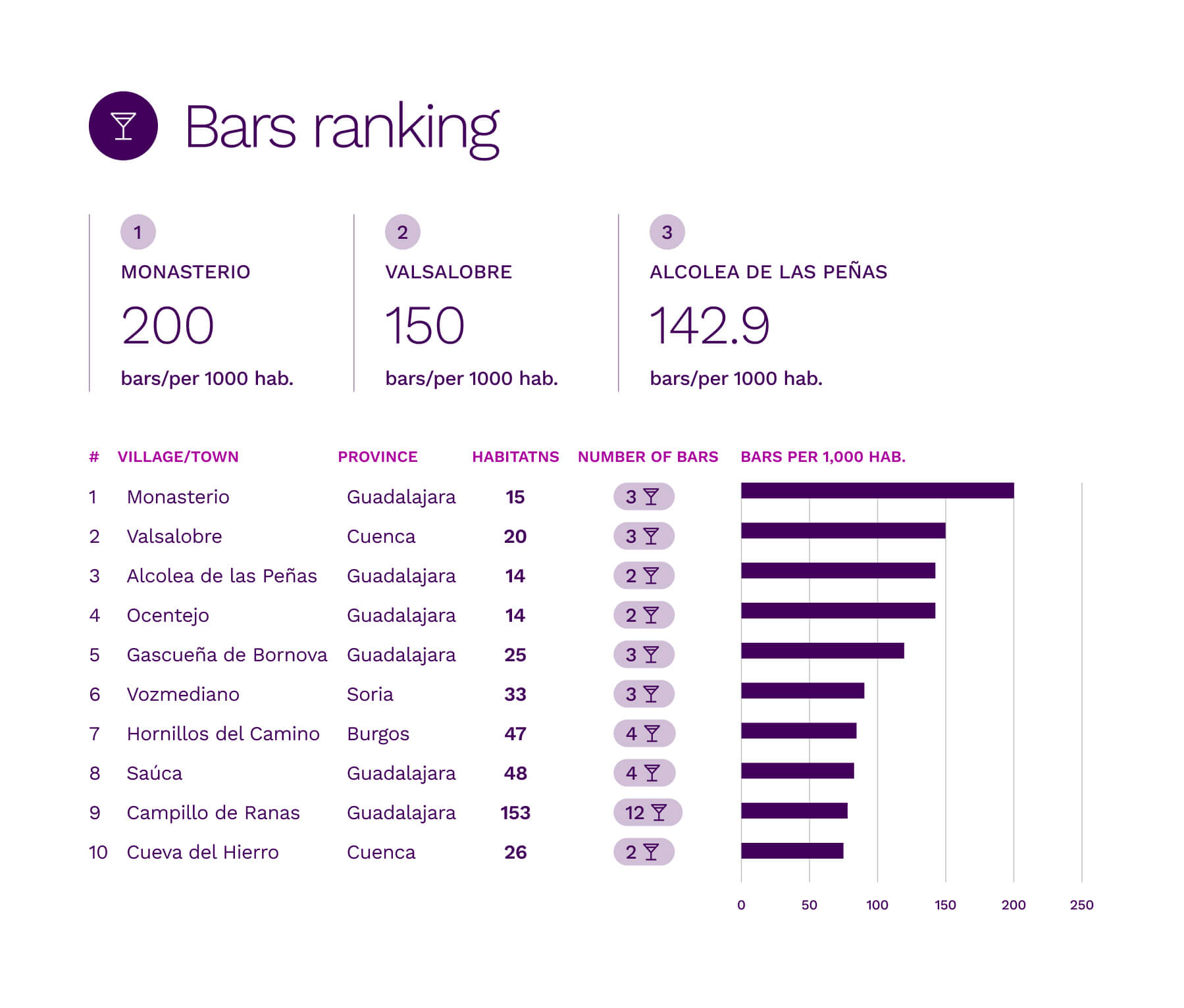
Among the municipalities with the highest density are small villages with a strong local identity or significant tourism activity. Monasterio (Guadalajara) tops the national ranking with three bars for just 15 residents, equivalent to 200 bars per 1,000 inhabitants.
Where there are more bars per inhabitant
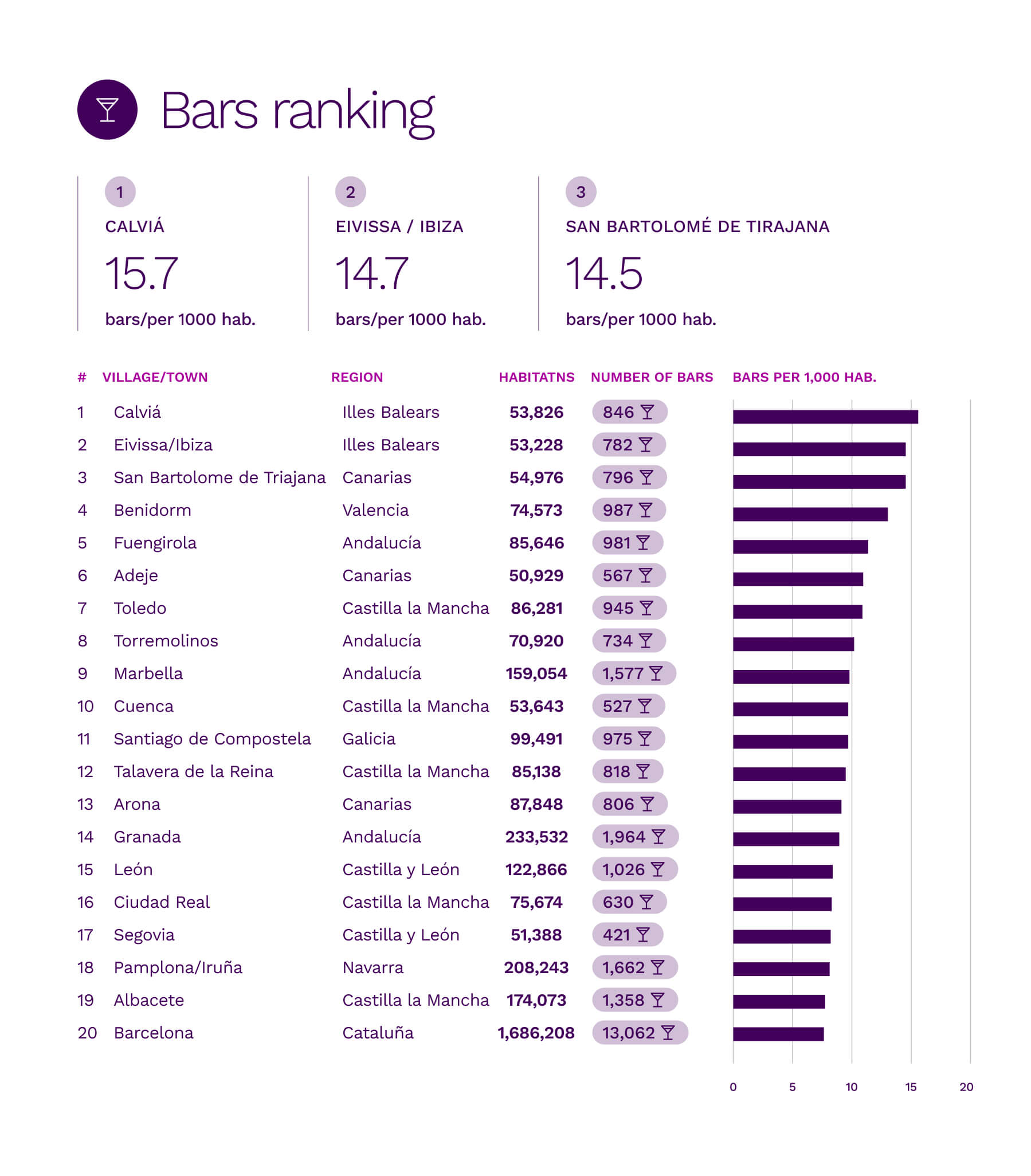
Filtering the data for towns with more than 50,000 residents paints a different picture. Renowned tourist destinations lead the ranking, where hospitality is both an economic driver and a local hallmark.
At the top sits Calvià (Balearic Islands) with one bar for every 63 people, followed by Ibiza, San Bartolomé de Tirajana, Benidorm and Fuengirola — all areas where tourism fuels dense networks of bars and restaurants.
Historic cities such as Toledo, Santiago de Compostela and Granada also stand out for their lively hospitality scenes, each with more than eight bars per thousand inhabitants.
The other side: municipalities with no bars
At the opposite extreme, Spain’s so-called “Empty Spain” draws a map of silence. Across the country, 2,375 municipalities have no bars at all, affecting more than 463,000 residents.
The provinces most affected are Soria, Palencia, Ávila and Burgos, where in some cases more than a third of municipalities lack this essential service. The absence of bars is not only an economic issue — it also signals a loss of community life, fewer gathering spaces and greater rural isolation.
Data that tells stories
For this analysis, we considered as a bar any establishment where you can have a coffee or a beer — from cafés and ice-cream shops to restaurants — according to our DataCentric Marketing business database, which integrates multiple data sources to provide the most comprehensive coverage of real-world businesses.
Using this dataset and our geospatial analytics technology, we built an interactive map where each point represents an actual establishment.
Zoom in, search your town, and discover how many bars are in your area:
Seeing value clearly
The data shows that bars mirror the vitality of each territory. Where they thrive, there is dynamism, tourism and community. Where they vanish, depopulation leaves a visible mark.
At Accumin Intelligence, we believe that seeing value clearly means understanding what data reveals about how we live, connect and grow. And in Spain, exploring the map of its bars is, in many ways, looking into the country’s own reflection.

Gerardo Raído