Where are the opportunities in Latin America’s residential markets?
In a context marked by more compact housing, public support schemes and changing buyer behaviour, understanding how each city is evolving has become essential for informed decision-making.
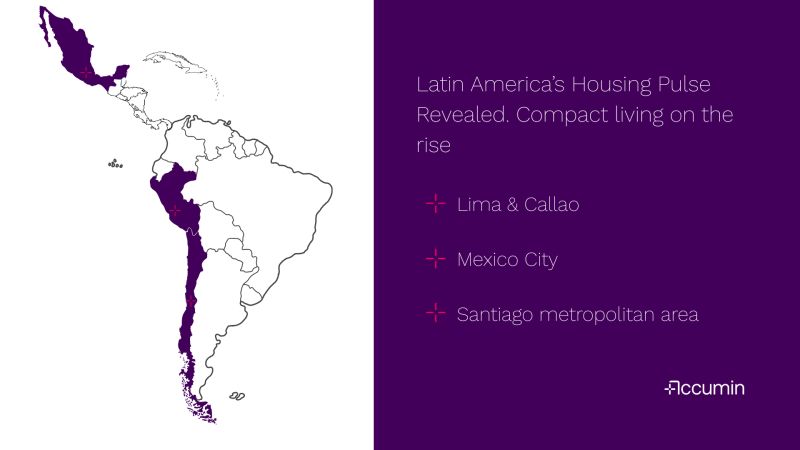
In an exclusive session for the EXATEC community, the global alumni network of Tecnológico de Monterrey, experts from Accumin shared insights drawn from the INCOIN register, focusing on the residential markets of Mexico, Chile and Peru.
Mexico City shows strong development activity, with more than 1,000 active projects, almost all of them vertical. Mid-range housing leads sales, while luxury accounts for a limited share. Long-term mortgages of up to 30 years and delinquency levels below 2% support demand. At the same time, average unit sizes have decreased, moving from around 90 square metres to 70.
In the Santiago Metropolitan Area, Chile, the market counts over 1,100 projects, alongside a gradual reduction in available stock that points to a healthier balance. One-bedroom units represent the largest share of sales. DS19 subsidies continue to support mid- and lower-income segments, while upcoming elections and new energy efficiency requirements are expected to influence market dynamics.
Lima and Callao, Perú, stand out for affordability. With more than 1,000 active projects and around 26,000 units in stock, the average price sits close to USD 130,000, the lowest among the three markets. Mortgage access from the pre-construction phase remains a competitive advantage, while developers increasingly rely on shared amenities to compensate for smaller private spaces.
Different cities, different realities. What they share is a market in transformation where access to reliable data is key to identifying opportunities.